

Kyiv and Beijing in Times of Global World Order Transformation
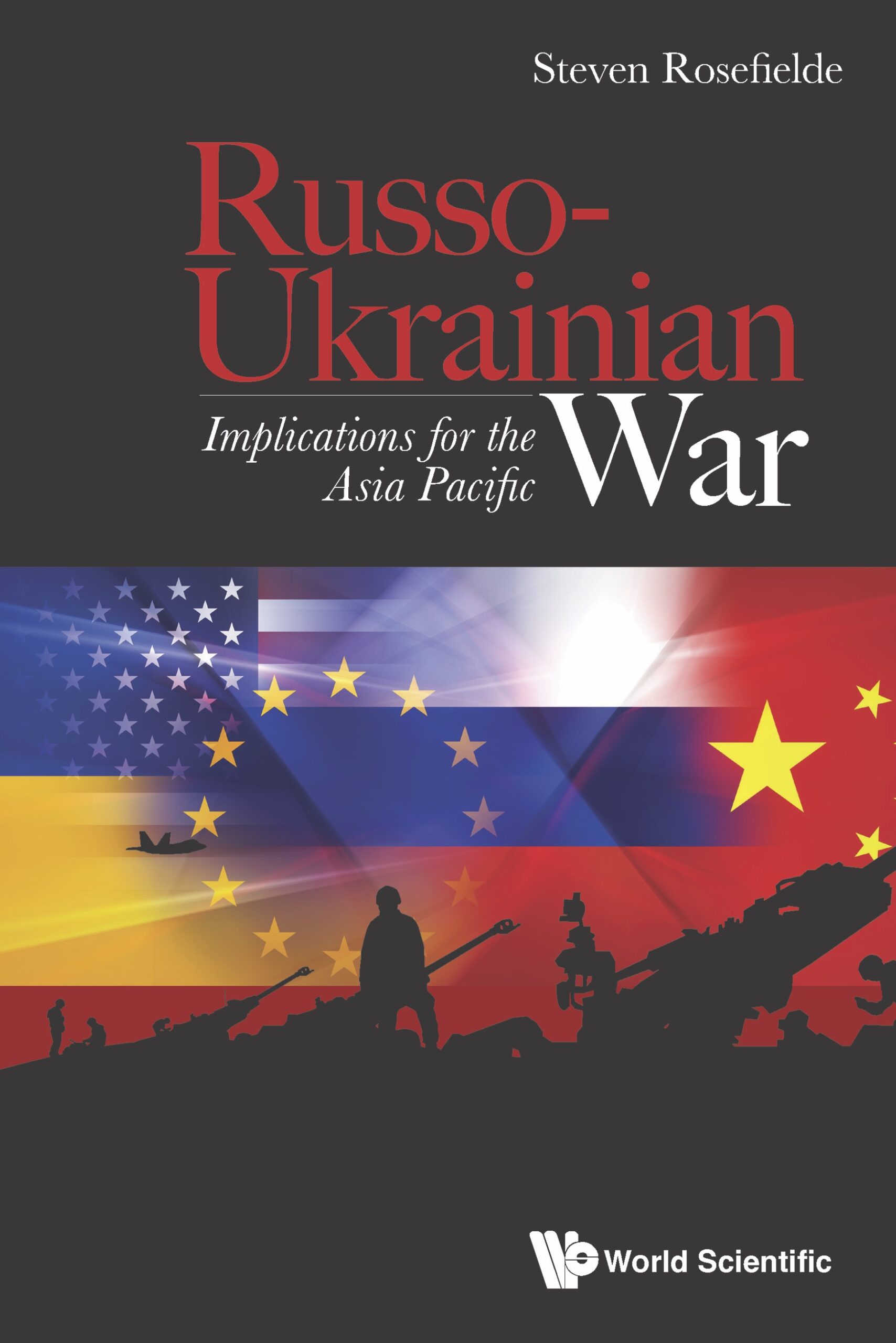
Interview with Steven Rosefielde, Professor of Economics at the University of North Carolina on his book “Russo-Ukrainian War: Implications for the Asia Pacific”
Vita Golod (V.G.): Dear Prof. Rosefield, thank you for accepting my invitation to the interview. I just finished reading your book, Russo-Ukrainian War: Implications for the Asia Pacific, and I have to say, it was eye-opening. You pulled together a lot of perspectives that many Ukrainians might not see, given our focus on survival, economic stability, and democracy. Your geopolitical take was refreshingly pragmatic. Given that you published the book in August 2023, how do you feel about your predictions now in 2025?
Steven Rosefielde (S.R.): The central thesis of Russo-Ukrainian War: Implications for the Asia Pacific is that America and NATO played a triple game in Ukraine. First they sought to shift Ukraine into the West’s orbit. Second, they sought relegate Russia permanent to the status of a sub-power. Third, they sought to chasten China by demonstrating the West’s power.
I did not predict the short term outcome of these contests, stressing instead the futility of using military power to permanently prevent Russia and China from achieving superpower status in the long run.
Between the lines, I implied that all three American-NATO objectives would not work out as hoped because Washington and Brussels refused to grasp Russia’s military industrial capabilities, the robustness of Russia’s workably competitive market economy, and Putin’s tenacity.
I believe with the benefit of hindsight, that my assessments were and remain valid.
V.G.: I know that you teach a course on the Russian economy, so there’s no doubt that you understand Russia’s industrial capabilities. In this context, do you think Russia’s economy, under severe Western sanctions, would have survived without the sharp ‘pivot to the East’—primarily the immediate support from the PRC? Their trade turnover has increased by about 30% so far, and Russia has successfully obtained nearly all the technologies it needs through Chinese suppliers or intermediaries. Not the only source, but certainly one of the key ones.

S.R.: Yes. Even if the embargo had been 100%, Russia would have replaced imports with import substitutes. Trade diversion to China and elsewhere provided a better option from the standpoint of consumer utility, but the GDP benefit was small. China provided Russia with non-economic geostrategic and geopolitical benefits too that are not reflected in the standard economic statistics. Taking all aspects into consideration, China significantly assisted Russia.
V.G.: I had the opportunity to read your scientific article on sanctions, in which you argued that Western sanctions have not achieved the desired effect due to a lack of rigorous cost-benefit analysis, instead relying on the assumption that continuous escalation would ultimately weaken Russia. However, secondary sanctions have had an impact—perhaps not a significant one—by obstructing trade circumvention through third-party nations such as China, India, and Turkey. We see how Russians have complained about these new barriers and are seeking alternative, albeit more expensive, channels. Talking about the Russo-Ukrainian war, which is the focus of your book, you argue that the U.S. is largely responsible for this war, failing to integrate post-Soviet Russia into a cooperative democratic system between 1992 and 2008. You also criticize Clinton’s handling of NATO expansion and say the Biden administration escalated things further in 2021 by “weaponizing” Ukraine. Do you think Ukraine’s leadership miscalculated in choosing the U.S. as our key ally? Some observers argue that without Western support, Ukraine could have ended up like Belarus—without real sovereignty. What’s your take?
S.R.: Ukraine’s leadership chose a high risk strategy. It partnered with NATO to reacquire Donetsk, Luhansk and Crimea with threats or if need be military force. At the time, and in retrospect, I believe that NATO and Kyiv underestimated the Kremlin.
Ceteris paribus, I do not believe that Ukraine would have ended up like Belarus. If Biden had acceded to Lavrov’s pleas in December 2021 to forego Ukraine’s accession to NATO, Ukraine’s sovereignty (excluding Luhansk, Donetsk and Crimea) would have remained intact, and the process of Ukraine joining the EU would have moved significantly forward.
V.G.: It’s an interesting point of view, even quit controversial. You stated in the book, “Biden and Blinken imprudently chose to be aggressive in Ukraine. They didn’t have to push Putin on NATO membership, but they did.” Let me ask again. Does that mean you see NATO expansion as the main trigger for the war? If so, why wasn’t Putin as alarmed about Sweden and Finland joining NATO? Also, how do you respond to historian Serhii Plokhy’s argument that Russia’s imperial collapse—not NATO—was the real cause of this war?
S.R.: The issue of Ukraine’s NATO membership was the trigger because NATO simultaneously committed itself to arming Kyiv sufficiently to retake Luhansk, Donetsk and Crimea. If NATO had accommodated Lavrov, Putin would not have launched his SVO on February 24, 2022. However, he probably would have done so later, if Ukraine were armed sufficiently to reconquer Luhansk, Donetsk and Crimea.
Sweden is militarily toothless. Finland can defend itself stoutly, but the Finns have no intention of fighting Russia abroad. The Finns no long even care about Karelia. (I have worked with FOI editor: the Swedish Defence Research Agency since 1975 and the Finns since the early 1990s).
Russia’s imperial collapse may have had some influence on Putin’s actions, but NATO expansion and ambitions were paramount.
V.G.: And now Putin’s appetite has increased for Kherson and Zaporizhzhia oblasts. Nobody knows what else he will need in the future. I think this was behind the Ukrainian elite’s strategy to secure collective transatlantic support as the only way to survive and distance itself from Russia’s zone of influence, which aligns with the aspirations of the Ukrainian people. You pointed out that Russia feared losing its remaining economic influence over Ukraine and saw the conflict as a means to mitigate these losses. Do you see this war more as Russia’s war for resources and economic benefits? Signing the 2021 U.S.-Ukraine Charter on Strategic Partnership was viewed as a great success in Ukraine. Now, the Trump administration is trying also to gain its own economic benefits. How would you comment on President Trump’s harsh business tactics, which contrast with Biden’s strategy? Do you still think, as you stated in your book, that a full-scale NATO-Russia conflict remains a possibility.
S.R.: Putin was aware of Donbas mineral wealth and more generally the economic potential of Crimea. I believe mineral wealth and other industrial assets strengthened his conviction that Luhansk, Donetsk and Crimea were worth fighting for, but this factor seems to me secondary.
I do not know what Trump really thinks about anything. I do not know whether he feels any obligation to treat Ukraine fairly. If I were Ukraine’s leader, I would go through the motions of placating Trump, while defending Ukraine’s interests as staunchly as possible.
The risks of a continuity of the full-scale war will be slight, if Trump continues on his current course.
Trump appears unwilling to fight, and Europe cannot wage war against Russia without full American support.
V.G.: Let’s talk about China. You mention that the PRC sees U.S. actions in Ukraine as a playbook for a de-facto Cold War 2.0 scenario against Beijing. Do you really think Ukraine and Taiwan are comparable situations?
S.F.: America’s play book against China resembles its Russia strategy. It uses economic sanctions, moral suasion, color revolutions and threats of force to pressure Russia to exit Ukraine, and China to refrain from invading Taiwan. The correlation of forces between Russia and NATO on one hand, and China and the West however differ and shape potential outcomes accordingly.
V.G.: I meant that Ukraine is an independent country, and almost all nations have acknowledged the One-China policy, so the international community’s reaction could be different if China attempts to change the status quo.
S.R.: Yes, I agree. Trump yesterday repudiated America’s One-China policy editor: on February 13, 2025, The U.S. State Department has removed a statement on its website that it does not support Taiwan independence. Biden privately was moving in the same direction.
V.G.: By the way, how do you assess the effectiveness of international institutions in responding to military invasions like the one in Ukraine, and what role do you see China playing in these responses?
S.R.: Once Biden committed himself to arming Ukrainian sufficient to reclaim Luhansk, Donetsk and Crimea (with restrictions), international institutions became irrelevant, until Biden had a change of heart.
V.G.: You’ve argued that neither the U.S., Russia, nor China can fully dominate the world order and that they’ll have to find a way to coexist. Do you still believe that, or have things shifted now in a way that might change your mind?
S.F.: Yes, I still believe that coexistence is achievable. It is better than Hot War and Cold War, and inferior to Cold Peace, except for those who insist that coexistence is intolerable, or a one way street to annihilation.
V.G.: It’s good to remain optimistic. I really liked your comparison between Russia and China. You even use the phrase “China is not Russia,” which reminds me of former Ukrainian President Kuchma’s book Ukraine is not Russia. Can you elaborate on what makes China’s trajectory so different?
S.R.: China’s economic system is institutionally superior to Russia’s for the purposes of Cold Peace, Cold War and Hot War. Both are managed, workably competitive market economies, but China is more entrepreneurial. Also, the population asymmetry is crucial, and it is impossible for the West to fight a land war on the mainland. Russia’s nuclear arsenal dwarf’s China’s.
V.G.: I agree. Economically, they are different. But people often compare them politically and ideologically, seeing their approach to global governance as similar since both are autocratic states opposing the Western coalition. I didn’t see you assess China-Russia rapprochement since 2022 in your book, or maybe I missed it. How would you comment on this perspective?
S.F.: The Sino-Russian rapprochement had not gained momentum when I finished my book in the early spring 2023. Soon thereafter it because a serious and negative unintended consequence of the Russo-Ukrainian War. Trump hopes to weaken the Sino-Russian entente. Trump, like most of Washington today, perceived China to be it most potent adversary.
V.G.: Just like the previous president did. You dedicated the whole Chapter to the impact of the Russo-Ukrainian war on the Asia-Pacific. You said that the U.S. wants to keep military superiority in the Asia-Pacific but that it’s just not politically sustainable. Do you think China is already the dominant power in the region? Can alliances like the Quad or a potential “Asian NATO” even serve as a counterbalance?
S.F.: China’s military is already numerically superior in the Asia Pacific, and the Pentagon concedes that it has closed or eliminated the technology gap.
The Quad helps sustain a military balance, but this is not enough because Washington refuses to fund the arsenal needed to deter China.
It is premature for me to assess Trump’s impact on American military preparedness.
V.G.: As an economist, you argue that sanctions on China—like the ones on Russia—could backfire. China’s market communism allows it to stay competitive while keeping party control, making it a very different economic challenge for the U.S. Given the continuation of Trump-era tariffs, where do you see U.S.-China trade going in the next four years?

S.F.: The tariffs Trump imposed on China during his first term as president had some beneficial domestic effect for industries seeking protection. China had to adjust reciprocally. American prohibitions against the export of high tech microchips did not stop China’s military modernization, or notably hamper its economic growth. There were no measurable macroeconomic consequences to either side.
Trump however was immensely successful in closing the US-China trade deficit. He got China to agree to import more American goods.
I expect the impact of Trump’s future tariffs to be microeconomic (benefiting some, harming others) rather that macroeconomic (affecting employment and long term sustainable growth).
V.G.: I agree. It was effectively implemented for the American economy, and China adapted to the hawkish terms at that time. However, by initiating a trade war with China, which has never truly ended, President Trump triggered what some call Cold War 2.0 between the two global powers. I’m concerned that this time, he may escalate tensions even further with China. In your Technology Transfer section, you mention China, Russia, North Korea, and Iran working together on cyber warfare, AI, and electronic warfare. You argue that the U.S. and EU were right to restrict tech exports to China, but maybe they did it too late? Do you think China could surpass the U.S. in key tech and military areas? Should we see China’s rise as a threat, or is it mostly defensive?
S.F.: The argument for embargoing high tech military components to any country is solely a national security issue. I support embargoing high tech military components to Russia and China. The case for embargoing is strong whenever the West has an advantage and policymakers judge that the advantage is strategically significant. There are no obvious reasons why China cannot surpass the U.S. in key tech and military area? Politicians are inclined to suppose their cultures give their nation an edge, but the justifications offered are lack scientific rigor. I assume instead that technological advantage is a function of the volume of resources devoted to research, testing and evaluation.
Xi Jinping’s military initiatives in the South China Sea and the resources he has committed to achieving military superpower lead me to infer that China is a threat to its neighbors. Violence however may not be necessary. He may be able to achieve his goals through intimidation.
V.G. Ok. I have another question. In your Taiwan section, you suggest China is closely watching how the U.S. handles Ukraine. You say Beijing is biding its time, waiting for its military and tech to be strong enough before making a move. Do you think China would ever actually invade Taiwan, or does that go against its “shared future for mankind” narrative?
S.F.: If I were Xi Jinping, I would partner with Taiwan. Invasion is superfluous. However, I am not him, and he may judge it politically advantageous to invade.
V.G.: Finally, on U.S.-China tensions—you describe their rivalry as a mix of miscalculations, conflicting ambitions, and no real exit strategy. Some even call it Cold War 2.0. Do you think this tension makes it harder for Washington and Beijing to sit down and talk about peace in Ukraine? Or is that just impossible at this point?
S.F.: I think that Washington and Beijing should sit down and talk about peace in Ukraine. This would contribute to global confidence building for peace.
Peace is not always the best option but it is wise to cultivate an environment that supports searching for consensus solutions. The word consensus implies adversaries accepting some outcomes they dislike to achieve a result they can live with.
The Japanese culture is very good at consensus building. Western cultural is more combative.
V.G.: I would say the Chinese is good at consensus as well. Since 1954, China has adhered to its fundamental foreign policy principles, including peaceful coexistence, which has been a beneficial strategy for China itself. However, it has not been particularly effective in mitigating current conflicts around the world.
S.F.: I am unable to assess the prospects for Xi Jinping’s foreign policy because China’s military power today is so vastly greater than it was earlier in the new millennium.
V.G.: Thank you, Professor Rosefield. This interview will be published in Ukrainian translation the “Ukraine-China” journal and in English on the website of the Ukrainian Association of Sinologists. I truly appreciate your time, insights, and perspective.
Interview conducted on February 22, 2025
Vita Holod, Ph.D., board member of the Ukrainian Association of Sinologists, visiting professor at the University of North Carolina at Chapel Hill